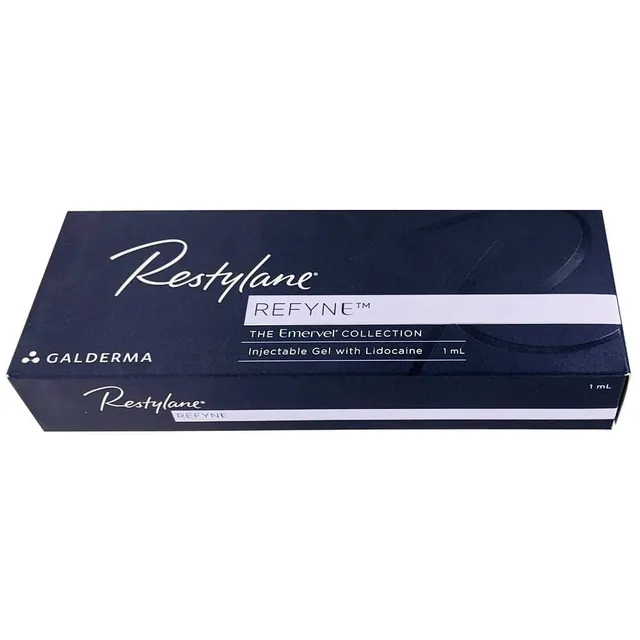
Restylane Refyne is an injectable gel from the Restylane range by Galderma. According to the manufacturer's instructions, it is intended to increase the volume of facial tissues, with indications including the correction of moderate wrinkles and the reshaping of the lips, cheeks, or tear troughs.
It combines cross-linked hyaluronic acid at 20 mg/ml with lidocaine at 0.3%. Lidocaine is included to improve comfort during injection.
The duration of effects varies depending on the patient and the treated area. In a randomized study on moderate to severe nasolabial folds cited in the Galderma instructions, efficacy was maintained for at least 48 weeks after the initial injection.
Indications / Treatment Areas
- Correction of moderate wrinkles
- Lip reshaping
- Cheek reshaping
- Tear trough reshaping
Characteristics
- Cross-linked hyaluronic acid: 20 mg/ml
- Lidocaine (hydrochloride): 3 mg/ml, i.e., 0.3%
- Packaging: 1 pre-filled syringe of 1 ml and 2 needles 30G ½"
Use
According to the instructions, the injection depth depends on the treated area and tissue support: mid to deep dermis, submucosal layer of the lips, hypodermis, or supra-periosteal plane. Injection is performed with the supplied needle or a 27G blunt-tip cannula, by a trained professional.
FAQ
Does Restylane Refyne contain lidocaine?
Yes. According to the European Galderma instructions, Restylane Refyne contains 3 mg/ml lidocaine hydrochloride (0.3%).
What are the indications for Restylane Refyne?
The correction of moderate wrinkles and the reshaping of the lips, cheeks, or tear troughs, according to the manufacturer's instructions.
What is the difference between Refyne and Defyne?
Both contain 20 mg/ml cross-linked hyaluronic acid and lidocaine. Refyne is indicated for moderate wrinkles, Defyne for severe wrinkles.
At what depth is Refyne injected?
From the mid to deep dermis, in the submucosa for the lips, in the hypodermis or supra-periosteal plane depending on the area and tissue support.
How long do the results last?
This varies depending on the patient and the treated area. The instructions cite efficacy maintained for at least 48 weeks in a study on nasolabial folds.